
Markets Hit Highest Point EVER
The stock market has gone crazy over the last few months.
Since the tariff crash in April, the S&P 500 index and NASDAQ are up almost 30% and 36%, respectively.
Both indexes hit all-time highs on Thursday.
Nvidia (ticker: NVDA) became the first company to cross $4 trillion in market cap on Wednesday.
Many investors, including me, are concerned the stock market is overvalued.
Overvalued means stock prices are much higher than their actual true value.
A great measure of whether the stock market is overvalued or not is to use a valuation ratio, like the price-to-earnings (P/E) ratio.
The current P/E ratio for the S&P 500 is 29.5x
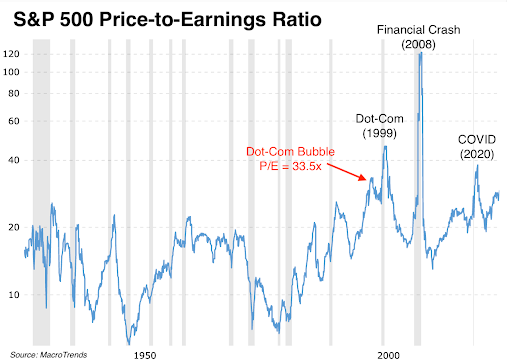
Outside of major market crashes and recessions, the P/E ratio for the S&P 500 hasn’t been 29.5x since the Dot-Com bubble in 1999.
Yikes!
Why exclude recessions and major market crashes?
Stock market prices are forward-looking, while earnings are historical.
Following a crash, stock market prices rebound before earnings, which elevate P/E ratios.
While the tariff crash in April was considered a crash, I wouldn’t call it a major crash.
Should we sell everything and wait?
Of course not!
Just because the stock market appears overvalued doesn’t mean there aren’t stocks at great prices.
Interest rates might be headed lower, which helps homebuilders like Lennar (ticker: LEN).
High interest rates have hurt Lennar. Homebuyers are priced out of buying new homes because of high mortgage rates… that means fewer sales.
Interest rates are expected to fall 50 basis points by the end of 2025 and drop 100 points by next summer.
With inflation lower than many anticipated, I think rates are going to fall even faster
And once those rates start dropping, Lennar’s phone will be ringing off the hook!
Lennar’s P/E ratio is less than 10x, making it one of the cheapest homebuilders in the entire S&P 500.
Low oil prices are hurting companies like Diamondback Energy (ticker: FANG).
Diamondback is an oil and natural gas producer in Texas with an incredibly low 8.75x P/E ratio.
The industry and Diamondback’s historical average P/E ratio is around 12x, so Diamondback is very cheap right now relative to its peers.
Diamondback’s P/E is a little crazy when you consider its 30% net margin, which is one of the highest in the entire energy sector.
Oil prices will be choppy in the near-term because of conflict in the Middle East, tariffs, and recession concerns.
But the price of oil won’t stay down forever, and once it rises, Diamondback will soar.
Just because a stock has a high P/E ratio doesn’t mean it’s a bad stock to own.
Amphenol Corp (ticker: APH) has a P/E ratio over 45x.
Amphenol, an electronic cable and connector production company, is up over 40% in 2025.
Yes, its P/E ratio is high, but Amphenol is incredibly profitable.
Amphenol’s net margin of 15% and a Return on Equity (ROE) close to 30% are in the top 10% of the entire Hardware industry.
Plus, Amphenol’s earnings have grown on average by 15% over the last five years.
Analysts predict Amphenol’s high growth rate will continue, with earnings in 2027 expected to be 70% higher than 2024.
Do you own any stocks hitting all-time highs recently?
Send me a message if you have any!